
Here is a fact that surprises almost every Decatur driver we tell it to: in the entire state of Georgia, there is no periodic vehicle safety inspection. None. Not annually, not every other year, not at the point of sale, not when a car changes hands between two people in a parking lot.
No state inspector has ever put your car on a lift. No sticker on your windshield says a third party checked your brakes, and no tag office clerk in DeKalb County is going to ask. A used car can pass through four owners in DeKalb County over fifteen years and never once have a trained set of eyes look underneath it, because Georgia car inspection requirements simply do not include that step.
That is the starting condition for every used-car purchase in Decatur and across south DeKalb County. Whether the car is sitting on a lot off Candler Road, parked in a driveway in Lithonia, or listed by an owner you are meeting halfway down Flakes Mill Road, the state’s involvement in its mechanical condition is zero. And that is why a pre-purchase inspection is not an optional extra you tack on if you are feeling cautious. It is the only checkpoint that exists.
Georgia car inspection requirements do not include a safety check. Not once.
Plenty of states run an annual safety inspection program. A shop checks brakes, tires, steering, lights, exhaust and wipers, and issues a sticker. It is not a perfect system, but it does mean a car with worn-through pads or a cracked control arm gets caught by somebody eventually.
Georgia has no equivalent. There is no safety inspection tied to registration, no inspection required when a title transfers, and no state agency that reviews the mechanical condition of a used vehicle before the sale. If a car will start and roll, it can be sold, titled and merging onto I-285 tomorrow morning.
That is not a loophole. It is how the state set it up. Georgia leaves the mechanical condition of a vehicle to the two people making the deal, which sounds reasonable enough until you notice that one of them is trying to sell the car and the other one has no way to see the underside of it.
The DeKalb County emissions test is the one check the state does run, and it is not a safety check
If you register a vehicle in DeKalb County, you already know about the annual emissions test. It applies in thirteen metro Atlanta counties, including ours, and for 2026 registration it covers 2002 through 2023 model year gasoline cars and light-duty trucks, with the three newest model years and anything twenty-five model years or older exempt.
A DeKalb County tag still needs a passing emissions result, so that part of the paperwork is real. What the test is not is a safety inspection. It reads the vehicle’s emissions system. It does not measure your brake pads, it does not check tread depth, it does not look at the frame, and it does not care whether a ball joint is loose.
Two things matter here if you are the buyer. Georgia’s Clean Air Force says that sellers inside the thirteen-county testing area are responsible for the vehicle having a passing emissions inspection at the time of sale, and a Vehicle Inspection Report stays valid for twelve months or one registration renewal. So the emissions box may already be ticked by the time you show up. That tells you the emissions system works. About the rest of the car it says nothing.
What Georgia law does not give you after you sign
Most buyers carry a vague sense that if the car turns out to be a disaster, something will protect them. In Georgia, for a used vehicle, almost nothing does.
- The Lemon Law covers new vehicles only. Georgia’s Lemon Law applies to a new motor vehicle purchased, leased or registered in the state, for the first 24 months after delivery or the first 24,000 miles, whichever comes first. Used vehicles are expressly not covered.
- The default is “as is.” Georgia’s Consumer Protection Division puts it bluntly: all vehicles are sold as is unless otherwise specified in writing, “as is” means no warranty, and verbal promises may not apply.
- There is no cooling-off period. The same division states there is no cooling-off period or statutory right to cancel a vehicle purchase contract, and that very few sellers will agree to let you cancel. The idea that you get a few days to change your mind is a rumor.
- A private seller owes you no disclosure form. The Federal Trade Commission’s Used Car Rule, which requires that Buyers Guide window sticker, applies only to dealers who sell or offer more than five used vehicles in twelve months. Somebody selling their own car is not covered and does not have to post one.
Put those together and the picture is plain enough. Nobody has to inspect the car, nobody has to tell you what is wrong with it, and the moment you sign, its condition becomes your problem. Whatever leverage you have, you have it before the money moves.
The FTC tells used-car buyers to ask to have the car inspected by an independent mechanic before buying, to pull a vehicle history report, and to check for open safety recalls. Georgia’s Consumer Protection Division says much the same thing, noting that pre-purchase inspection services which professionally examine and road-test a vehicle are increasingly common, and that plenty of mechanics and service centers will inspect a car before you buy it.
What a used car inspection in Decatur finds that a test drive cannot
This is the part that matters. A test drive tells you how a car behaves for fifteen minutes on roads you already know. An inspection tells you what condition the car is in. Those are different questions, and the second one can only be answered with the wheels off the ground.
Here is what our technicians are looking at during a used car inspection in Decatur, with the car in the air and the wheels off.
Frame and undercarriage. Body panels can be blended, and paint can be matched. What is harder to hide is the structure underneath: pulled or kinked frame rails, crushed pinch welds, fresh undercoating in one area and forty thousand miles of road grime everywhere else. A car that was rear-ended and repaired to look right can still show all of that from below.
Brake life, measured instead of guessed at. Quiet brakes are not proof of good brakes. Pads squeal when a wear indicator makes contact, and a pad with a thin layer left can stay perfectly silent right up until it does not. With the wheels off, a technician measures what is remaining on pads and rotors and tells you how much service life you are actually buying. We wrote separately about how stop-and-go traffic here wears pads by the number of stops rather than the odometer, and a used car’s history of city driving tells you more about its brakes than the mileage does.
Tire life and tire condition. Georgia law sets a floor of 2/32 of an inch of tread measurable in all major grooves, and requires tires to be free of cuts, breaks or snags deep enough to expose the body cord, and free of bumps, bulges or separations. Tires that look acceptable from standing height can be at or under that legal minimum in the inner grooves, which you cannot see until the wheel is up. Uneven wear across a tire is worth reading too, since it often points at alignment or suspension rather than at the tires themselves. “The tires look fine” turns into a number.
Fluid condition and leak evidence. A slow rear main seal or a differential that seeps will leave a film across the underside of a car without ever dripping enough to mark a driveway during a short drive. Coolant residue, burnt transmission fluid, weeping shocks, a power steering line starting to sweat: all of it reads plainly from underneath.
Suspension and steering play. With the weight off the wheels, a technician can grab a tire and feel what a road test masks: worn ball joints, tired tie rod ends, sloppy control arm bushings, bad wheel bearings. On a smooth stretch of highway none of that necessarily shows up.
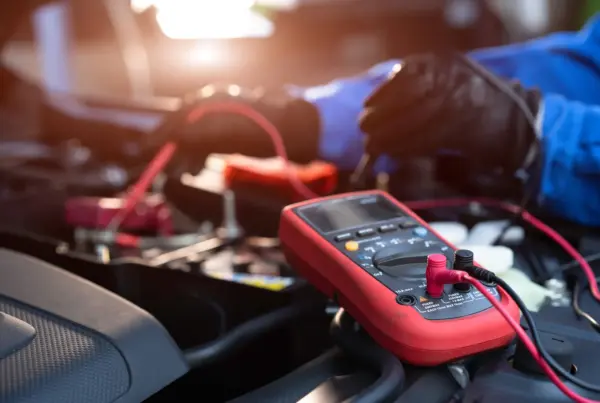
Stored trouble codes and open recalls. A scan tool reads what the car’s computer has recorded, including faults that were cleared recently and readiness monitors that have not reset yet. That is the same condition that makes a car show “Not Ready” at a DeKalb emissions station, and it can mean somebody erased a check-engine light shortly before listing the vehicle. A recall check belongs here too. CARFAX reported in March 2025 that one in five cars in the United States has an unfixed safety recall, and recall work is performed at no charge by a franchise dealer.
Why a clean listing and a good test drive on Memorial Drive are not evidence
A vehicle history report is genuinely useful and you should pull one. Just understand what it is, which is a record of events that got reported. An accident settled privately, body work paid for in cash, or a flood that never generated an insurance claim can leave a history report perfectly clean.
The test drive has the same limitation. It is a short sample under favorable conditions, on a route the seller picked, in a car that was probably warmed up before you arrived. A loop down Memorial Drive and back is not a diagnosis. It will catch an obvious transmission problem. It will not catch pads with a sliver of material left, a seeping seal, a cracked motor mount, or a frame that was pulled straight enough to look normal.
Neither of those is a substitute for somebody putting the car on a lift. They are inputs. The inspection is the evidence.
When to schedule a pre purchase inspection in Decatur GA
Before money changes hands. That is the whole answer, though a few practical notes help.
Book it while you can still walk away, because that is the only moment your findings carry any weight. If the car needs tires and rear brakes, that is a fact you can raise with the seller before you sign, and a fact you simply own afterward.
Do it before the title clock starts, too. The Georgia Department of Revenue gives a buyer 30 days from the purchase or transfer date to apply for a title at the county tag office. Once that clock is running, the transaction is over and you are managing consequences instead of making a decision.
With a private seller, ask to bring the car to a shop of your choosing, and name one. Somewhere close to where you are meeting makes it easy to agree to. A seller with nothing to hide will usually say yes. A flat refusal is information all by itself. At a lot, the same request is routine, and the FTC tells buyers to make it.
If you want to know what an inspection, or any repair it turns up, would involve for a specific vehicle, ask us for a current quote rather than working from a figure you found online. What it takes depends on the car and on what we find, so we would rather give you a real number for your situation than a guess.
Bring it to either Decatur shop before you buy
Georgia is never going to inspect that car for you. Not before the sale, not at the DeKalb County tag office, and not at any point in the years you own it. The pre-purchase inspection is the only look anybody is going to take, and it is on you to arrange it.
Our two Decatur shops, one on S Hairston Rd and one on Flakes Mill Road, handle pre purchase inspection work in Decatur GA for local buyers every week, including people who pull in with the seller still waiting in the parking lot. If you have been searching for a used car inspection near you in south DeKalb, either location can take the car. Bring us the car before you sign. Request a quote, tell us the year, make and model you are looking at, and we will tell you what you are actually buying.